
Saturday, March 26, 2016
The Exsultet at Holy Saturday
The EXSULTET is one of the most spectacular moments of all the Church’s liturgical life.
When it is sung well in Latin the Church is in her glory!
Like a Eucharistic Prayer the Exsultet is a remembrance (anamnesis) which makes the past mysteries present to us. The singer deacon begs the congregation to pray for him as he tells the story of our family history of salvation with all the foreshadowing and “types” of our redemption. So great is God’s ability to turn evil to good that the deacon dares to call Adam’s fall our “happy fault… felix culpa” since because of it we were sent the gift of our Savior. You hear of the work of bees and the shattering of chains of sin. All evil is driven away.
The constant refrain is that this is a blessed night when heavenly and earthly realities merge together and become one.
Finally, there is a humble petition that God the Father will accept our Paschal candle, our evening sacrifice of praise, and make it into one of the lights of the heavens.
This poem/hymn/prayer is too much to grasp all at once. But year by year we have the chance to hear it renewed in the heart of the Church’s greatest night. The mysteries within it do not change, but we do. Each year we are a little different. We can hear it each year with new insight and understanding.


What happened to Jesus on Holy Saturday?? Do you know?

We have all at times felt a frightening sensation of abandonment, and that which makes us most afraid of death is precisely this [abandonment]; just as when as children we were afraid to be alone in the dark and only the presence of a person who loves us could reassure us. So, it is exactly this that happened in Holy Saturday: In the kingdom of death there resounded the voice of God. The unthinkable happened: that Love penetrated “into hell” (“negli inferi”): that in the most extreme darkness of the most absolute human solitude we can hear a voice that calls us and find a hand that takes us and leads us out. The human being lives by the fact that he is loved and can love; and if love even has penetrated into the realm of death, then life has also arrived there. In the hour of extreme solitude we will never be alone: “Passio Christi. Passio hominis.” - Pope Benedict, 2010
Thursday, November 5, 2015
Anne of Green Gables

"Isn't it splendid to think of all the things there are to find out about? It just makes me feel glad to be alive--it's such an interesting world. It wouldn't be half so interesting if we know all about everything, would it? There'd be no scope for imagination then, would there?"
- Lucy Maud Montgomery, Anne of Green Gables
Our daughter has always loved the 'Anne of Green Gables' stories and read them avidly when she was just a young person and even into adulthood. She so loved and admired the character Anne that she named her first little girl after her. She is a beauty and, I am sure, with Jana's help will grow into a lovely woman.
Tuesday, October 27, 2015
Why we need to remember the Saints and Martyrs of our faith

Saint John Houghton, O.Cart., (c. 1486-London, 4 May 1535) was a Carthusian hermit and Catholic priest and the first English Catholic martyr to die as a result of the Act of Supremacy by King Henry VIII of England. He was also the first member of his Order to die as a martyr.
Houghton, along with the other two Carthusians, Fr. Reynolds, and John Haile of Isleworth, was hanged, drawn and quartered at Tyburn on 4 May 1535.[3]
The three priors were taken to Tyburn in their religious habits. From his prison cell in the Tower, St. Thomas More saw the three Carthusian priors being dragged to Tyburn on hurdles and exclaimed to his daughter: "Look, Meg! These blessed Fathers be now as cheerfully going to their deaths as bridegrooms to their marriage!" John Houghton was the first to be executed. After he was hung, he was taken down alive, and the process of quartering him began.
Catholic tradition relates that when Houghton was about to be quartered, as the executioner tore open his chest to remove his heart, he prayed, "O Jesu, what wouldst thou do with my heart?" A painting of the Carthusian Protomartyr by the noted painter of religious figures, Francisco Zurbarán, depicts him with his heart in his hand and a noose around his neck. In the Chapter house of St. Hugh's Charterhouse, Parkminster, in England, there is a painting depicting the martyrdom of the three priors.
After his death, his body was chopped to pieces and hung in different parts of London. He was beatified on 9 December 1886 and canonized on 25 October 1970.
Friday, September 11, 2015
Sin wounds the image of God in us......

I worry about sinning and separating myself from God. He cannot dwell in a sinful vessel, yet it appears that He does. It's very confusing to me. I mean, does God pop out of my soul whenever I think or do something against His commandments and then pop back in as soon as I make a good confession? I fret over making a "good" confession -- what's that anyway?! When I knowingly do something wrong, I ask Jesus to forgive me and fill me with the Holy Spirit and the graces I need to live a holy life. I think He does it--as long as I am sincere; however, the Catholic church teaches us that we must confess our sins to a priest. This is very hard for me. I fumble around with my confession and hope that I did it right and always feel better when the priest pronounces forgiveness and absolution from my sins. And yet.....I go away wondering if it really worked.
St Augustine teaches that original sin wounds the image of God in us, and it is this wound that needs healing. St Paul defines sin this way--he says, “All have sinned and fallen short of the glory of God.” And yet...God calls us to 'Be perfect, as your heavenly Father is perfect". How do we do that? Seems impossible.
My daughter re-posted an article on this topic the other day and it has helped me tremendously. Just in case I thought I was making some progress on my spiritual journey, I can always meditate on the Cardinal Virtues. A personal reflection might look like this:
Have I practiced the virtue of Chastity? For example:
• Have I permitted myself to watch movies or television shows that are not edifying; ones that depict sexual scenarios or advocate for cohabitation or homosexual relationships?
Have I practiced the virtue of Temperance? For example:
• Have I indulged my love of sweets or snack foods, to the detriment of my health?
• Have I continued to consume alcoholic beverages excessively?
• Have I been immoderate in any activity, such as watching too much TV?
Have I practiced the virtue of Charity? For example:
• Have I been a “busybody,” unkind to a neighbor either by my thoughts or by my actions?
• Have I had a smile for a family member or loved one, or was I critical, hurting someone’s feelings?
Have I practiced the virtue of Diligence? For example:
• Have I used my physical limitations as an excuse for laziness?
• Have I neglected prayer, ignored my friend’s birthday, sat around the house when I might have helped with chores?
• Have I exercised my responsibility to become familiar with political issues, and to vote for the candidates who will best protect Christian values.
Have I practiced the virtue of Patience? For example:
• Was I unkind (or downright rude) to a telephone caller, supermarket clerk, or visitor. Was I crabby when things didn’t go just the way I wanted?
• Did I complain about the service at a restaurant because we had to wait for service or the waitress wasn't "on top of things"?
• Did I criticize my doctor, my caretaker, my child, for not serving me better?
Have I practiced the virtue of Kindness? For example:
• Was I jealous of the attention paid to someone else, wanting everyone to notice me instead?
• Did I feel angry because my grown children did not have enough time to spend with me?
• Did I compliment someone who looked good, or did I only have harsh words to say?
Have I practiced the virtue of Humility? For example:
• Did I accept a compliment graciously but then move on, refusing to keep the attention turned toward myself?
• Was I willing to let someone else be the center of attention?
• Did I feel grateful for the kindness of my family and other’s efforts?
I read a book in 2012 called, 'Why Catholicism Matters' by Bill Donohue. It helped me to come to the understanding that only through the inculcation of these virtues in one's life, can we ever hope to 'Be perfect as your heavenly Father is perfect'. The author makes a wonderfully poignant statement when he says, " How can we craft a society that pushes us to be our neighbor's keeper? Then, he quotes Pope Benedict XVI, "authentic service requires sacrifice and self-discipline, which in turn must be cultivated through self-denial, temperance and moderate use of the world's goods."
Tuesday, September 8, 2015
How Much Do I Love God?

Whoever it is you love the least, is the height of your love for God or The neighbor you love the very least is the measure of the depth of your love for God. I never thought of loving God in this way and I am so glad that I heard her say this today. It really helps me to grow in my faith.
How about you? How much do you love the person that you like least of all?
Monday, August 3, 2015
Today is Toby's birthday


Nearly six and a half years ago God gave me a much needed gift -- Toby. I didn't think my heart was ready to hold another dog in it, but, I was wrong and God knew what I needed. Our dear Cassie died on March 7, 2008 and it broke my heart -- I won't write about it right now, but the date has a bearing on Toby's story. A year later, Alan was ready for another companion and was actively looking for one. Craigslist had a post for an Australian Shepherd puppy, so he persuaded me to go take a look. The dog was in Davis - a long drive.
Once we arrived and opened the door of the car, Toby came rushing over and hopped into the back seat. I couldn't believe it!! What a precocious little dog. We took a walk with Toby's "human caregiver", Toby, and his companion, 'Ashes' (a beautiful old border collie). Toby's owner, a doctor, talked about how important it was to treat dogs like dogs and not humans and she was very interested in making sure that Toby would get training. We didn't realize that we were being interviewed as potential caretakers until the hour long discussion and walk where she ended it by saying she had other people who were interested and she would let us know.
Feeling a little confused (we thought Toby was a 'rescue' dog as advertised) and sad, we said our good-byes to Toby and drove away. Finally we received a call from her to say that she had selected us as Toby's new owners and we could come and pick him up. The day we picked him up was the same day that Cassie had died the year before (Alan told me this later). Also, when I looked at Toby's litter certificate, it said he was born on August 3rd. The same day as Cassie -- only years later of course!! This couldn't be a coincidence and we felt that God was letting us know how much he cares about us and gave us this wonderful gift to ease our hearts and finish the healing process from Cassie's loss.
Well, today Toby is seven years old and he has been such a wonderful companion to us. He is always energetic and happy (except when we walk by certain dogs in the neighborhood) and loves to make sure we get our exercise.
I thank the Lord that He loves us so much and cares about every little thing.
Thursday, July 30, 2015
The Stag at eve had drunk his fill.....

The Stag Hunt
Sir Walter Scott (1771–1832)
From “The Lady of the Lake,” Canto I.
The stag at eve had drunk his fill,
Where danced the moon on Monan's rill,...
Then, as the headmost foes appeared,
With one brave bound the copse he cleared,
And, stretching forward free and far,
Sought the wild heaths of Uam-Var...
A moment listened to the cry,
That thickened as the chase drew nigh;
Then, as the headmost foes appeared,
With one brave bound the copse he cleared,...
For jaded now, and spent with toil,
Embossed with foam, and dark with soil,
While every gasp with sobs he drew,
The laboring stag strained full in view...
The wily quarry shunned the shock,
And turned him from the opposing rock;
Then, dashing down a darksome glen,
Soon lost to hound and Hunter's ken,
In the deep Trosachs' wildest nook
His solitary refuge took.
Sunday, July 26, 2015
Angels guarding Graveyards

Friday, July 24, 2015
Best Obit I ever read.....

When you read this you can't help but feel like you know her and you sense the humor and love that was and remains alive in this family.
Pat Stocks, 94, passed away peacefully at her home in bed July 1, 2015. It is believed it was caused from carrying her oxygen tank up the long flight of stairs to her bedroom that made her heart give out. She left behind a hell of a lot of stuff to her daughter and sons who have no idea what to do with it. So if you're looking for 2 extremely large TV's from the 90s, a large ceramic stork (we think) umbrella/cane stand, a toaster oven (slightly used) or even a 2001 Oldsmobile with a spoiler (she loved putting the pedal to the metal), with only 71,000 kilometers and 1,000 tools that we aren't sure what they're used for. You should wait the appropriate amount of time and get in touch. Tomorrow would be fine. This is not an ad for a pawn shop, but an obituary for a great Woman, Mother, Grandmother and Great-Grandmother born on May 12, 1921 in Toronto, the daughter of the late Pop (Alexander C.) and Granny (Annie Nigh) Morris. She leaves behind a very dysfunctional family that she was very proud of. Pat was world-renowned for her lack of patience, not holding back her opinion and a knack for telling it like it is. She always told you the truth even if it wasn't what you wanted to hear. It was the school of hard knocks and yes we were told many times how she had to walk for miles in a blizzard to get to school, so suck it up. With that said she was genuine to a fault, a pussy cat at heart (or lion) and yet she sugar coated nothing. Her extensive vocabulary was more than highly proficient at knowing more curse words than most people learned in a lifetime. She liked four letter words as much as she loved her rock garden and trust us she LOVED to weed that garden with us as her helpers, when child labour was legal or so we were told. These words of encouragement, wisdom, and sometimes comfort, kept us in line, taught us the "school of hard knocks" and gave us something to pass down to our children. Everyone always knew where you stood with her. She liked you or she didn't, it was black or white. As her children we are still trying to figure out which one it was for us (we know she loved us). She was a master cook in the kitchen. She believed in overcooking everything until it chewed like rubber so you would never get sick because all germs would be nuked. Freezing germs also worked, so by Friday our school sandwiches were hard and chewy, but totally germ free. All four of us learned to use a napkin. You would pretend to cough, spit the food into it and thus was born the Stocks diet. If anyone would like a copy of her homemade gravy, we would suggest you don't. She will be sorely missed and survived by her brother George Morris, children: Shauna (Stocks) Perreault, Paul/Sandy (Debbie) Stocks and Kirk Stocks, son-in-law Ian Milnes and son from another mother, John McCleery, grandchildren: Lesley (Sean), Lindsay (Lucas), Ashley (James), David (Tia), Brett, Erin (Brian), Sean, Alex, Courtney and Taylor and great-grandchildren: Connor, Emily, Ainsley, Tyler and Jack. She was preceded in death by her loving husband Paul (Moo) Stocks and eldest daughter Shelley (Stocks) Milnes and beloved pets Tag, Tag, Tag and Tag. All whom loved her dearly and will never forget her tenacity, wit, charm, grace (when pertinent) and undying love and caring for them. Please give generously to covenanthousetoronto.ca "in memory". A private family 'Celebration of Life' will be held, in lieu of a service, due to her friends not being able to attend, because they decided to beat her to the Pearly Gates. Please note her change of address to her new place of residence, St John's York Mills Anglican Church, 19 Don Ridge Drive, 12 doors away from Shelley's place.
http://www.creativeminorityreport.com/2015/07/this-is-one-heck-of-obituary.html
Wednesday, July 8, 2015
Who is Luke's Saint?

Luke's saint turns out to be St. Angela Merici who was born on March 21st, 1474, at Desenzano on Lake Garda; left an orphan at the age of ten she was brought up by her uncle and on his death went to live with her brothers. She was a devout girl and, having joined the Third Order of St. Francis, devoted herself to teaching children. As her work became known she was asked to go to Brescia where a house was put at her disposal and a number of women came to join her; she was thus enabled to establish a religious association of women, under the patronage of St. Ursula, who, remaining in the world, should devote themselves to every sort of corporal and spiritual work of mercy; but the particular emphasis was on education. Angela's methods were far removed from the modern idea of a convent school; she preferred to send her associates to teach girls in their own families, and one of her favorite sayings was, 'Disorder in society is the result of disorder in the family'. It was by educating children in the milieu in which they lived that she strove to effect an improvement in social conditions.
Angela Merici is known now as the foundress of the Ursuline nuns. Her plan of religious women without distinctive habit, without solemn vows and enclosure, was directly contrary to prevailing notions of her time, and under the influence of St. Charles Borromeo at Milan and subsequent papal legislation (under St. Pius V) the Ursulines were obliged to adopt the canonical safeguards then required of all nuns.
Angela Merici died in Brescia on January 27th, 1540.
Read more: http://www.ewtn.com/saintsHoly/saints/A/stangelamerici.asp#ixzz3fLKR1nBi
Who is Abigail's Saint?

Nobly born in France in the early fifth century, Hilary came from an aristocratic family. In the course of his education he encountered his relative, Honoratus, who encouraged the young man to join him in the monastic life. Hilary did so only after his relative had prayed for three days for Hilary's conversion of heart. From the moment of his conversion there appeared in Hilary that wonderful change which the Holy Ghost produces in a soul which he truly converts. His words, looks, and whole comportment breathed nothing but humility, patience, sweetness, mortification, and charity. Every one saw in him a man who began to labor in earnest to save his soul, and who had put his hand to the plough to look no more behind him. Aspiring to perfection, he sold all his several estates to his brother, and distributed all the money accruing from the sale among the poor, and the most indigent monasteries. Thus disengaged from the world, and naked, no less in the inward disposition of soul than in his exterior...He continued to follow in the footsteps of Honoratus as bishop. Hilary was only 29 when he was chosen bishop of Arles. Hilary died at 49. He was a man of talent and piety who, in due time, had learned how to be a bishop.
St. Honoratus, the eloquent bishop of Marseilles, who has given us an abstract of his life, relates several miraculous cures wrought by the saint while he was living. His body lies in a subterraneous chapel, under the high altar, in the church of St. Honoratus at Arles, with an elegant ancient epitaph. The name of St. Hilary stands in the Roman Martyrology.
Oftentimes we think of the lives of the saints as perfect and smooth. Saint Hilary’s life reminds us that human struggles are part of the Lord’s plan for us, part of His calling to us, part of our refining process. Through prayer, penance, and fasting, Saint Hilary overcame his human weakness, increasing his obedience, and submitting himself to the will of God; but, it wasn’t easy and it took his entire life! We are encouraged by Saint Hilary when we, ourselves, struggle—that while we work to understand and follow the Lord’s will, our time on earth will yield holy fruit if we strive for virtue!
http://www.ewtn.com/library/MARY/STHILARY.htm
Tuesday, July 7, 2015
Monday, July 6, 2015

Tuesday, June 23, 2015
My old family home

My parents bought this home brand new in 1963. I can still remember how I felt seeing this house for the first time -- I was in love! I thought it was the most beautiful home I had ever seen. Now, 52 years later with my parents both gone, it will become someone else's home. My parents took care of six kids, several dogs and cats, not to mention my brother's snakes and lizards, numerous neighbor children, visiting aunts, uncles, cousins, and friends by serving up heapfuls of food, good conversation, and lots of love. Oh, there were fights and disagreements to be sure, but there was always the making up, the "I'm sorry" and I love you. Not a night went by that my parents wouldn't say, "Sweet dreams". It always made me feel safe, secure, and loved.
When I think of this house, I think of my Mom and Dad; their warm and inviting manner; their love and concern for all. I miss this house because of them. I walked away the day my Mom died last December and have never returned leaving the cleaning and repairing to others.
I pray that the next family who owns this home will enjoy and love it making new memories of their family, pets, and friends that they will cherish in later years.
Guys cannot change the way they're wired.....

Guest blogger post:(annonymous)
Guys cannot change the way they're wired -- we're talking biology here, and it isn't really fair to expect them to do so....they, of course, can pray for God to change their hearts and ask for the grace to change and not see women as "objects". The natural response to stimulus, e.g. women's breasts or tight pants; they may try to avert their eyes, say a prayer for grace, but their bodies, due to natural instinct, still respond to this visual stimulation. That is why I think women should dress modestly. God has asked us not to be a stumbling block to others in their walk, and so we should take this into consideration.
Here is a further explanation of what I mean:
If this is the Abbey-Roads blog, then yes I read the post. I have a book on this topic called Dressing with Dignity that explains the position better and has lots of wonderful quotes from saints and the popes. I think while the Marylike standards are appropriate in most cases, there are good exceptions. Doing any sort of cooking, cleaning or manual labor can make sleeves hazardous, which is why people rolled them up.
First, we come to climate. What you wear in the majority of Europe is different than what you might wear in Central America. Heat exhaustion is very real and much of our dress habits revolve around safety as much as fashion. Finding clothing that is socially appropriate is as much a concern. Fabrics are different now. Most fabric manufacturers cheat in the weaving, adding slubs and thinning out the weave. Finding good material at an affordable price is challenging. I think many would be quite scandalized at the cost of good material. Add to that the cost of having the clothing made, either by your time or by paid labor, and many would see it as flaunting wealth (very common problem in the 1800s and before).
In the bible there are warnings to men to not wear women's clothing. Today, we would interpret that as wearing a dress, but at the time the bible was written and for 1500 years afterwards, men did not wear slacks. That is largely a Victorian invention that took about 100 years before women were able to adopt them. Before that men wore breeches if they were poor and hose if they had wealth. Their tunics and dublets were long to cover. Italian Renaissance painting are good examples of common dress for men, essentially what we would consider a dress. Robes were typical of all people for thousands of years. Many in the middle east still embrace this style. It's a good style too since it keeps the people protected from the hot sun and prevents a lot of moisture loss.
So, what were the differences between men and women at the time those letters were written? Today we would say they all dressed alike. Really, it comes down to fashion. Women would wear color more. Men would be in earthier tones or black. Material for most women of any status would be lighter and more delicate. Cut of clothing would also be different too. Status was seen in clothes. The more material you wore the more money you had. Trim, jewels, adornments were all seen as a display of wealth. Women often wore layers and layers of fine fabrics. Veil materials were so thin you could see through them, we can't replicate this today as it's a lost art. Look at paintings from the Renaissance and before to see the sheerness of those veils.
In all times, women always did something to help support the breasts. Linen binding was the most common. In the Renaissance, they turned to the corset to help with support and provide a cleaner line for the fabric to be draped on. That developed into different styles ending in our modern bra.
Veils are specifically mentioned in the bible. Women are to veil in the presence of God and men are to bear their heads. This comes down to psychology. Woman's hair was considered her glory. To cover it was to hide her beauty like the veiling of the Holy of Holies in the Temple. It is a muting of beauty to prevent distractions and vanity. Wearing a veil, when everyone wears one, becomes like blinders on a horse. You cannot see around you without turning your head. Your focus is on what is in front of you. It also covers your hair which was often elaborately braided or coifed. Men on the other hand are known for balding. Their hair is not their beauty. To take off their hat is an act of humility because they must bare their heads. Think of all the hair loss treatments for men. No longer is veiling required at church, although that is a lament, because it was deemed more fashion than soul altering. I think they would change their minds now but find the challenge too great to deal with. It is strongly recommend in the TLM and many places will offer a spare veil to wear if you don't have one, I saw this at one of the missions we went to on our honeymoon.
It's going to come down to some common sense (educated).
We want to avoid cleavage displays, so the top needs to be high enough so that if you were to bend over you don't display everything you have. Some sort of undergarment support is needed.
Clothing shouldn't cling but skim or be fitted (clinging is more in reference to the bias cut dresses of the 1930s). Fitted clothing can be very appropriate. Bodices often helped in supporting the bust. We don't dress like this anymore but it is an example where the purpose of the clothing must be understood.
Pants will typically look sloppy. Because we stretch the material when we sit down, the resulting effect on the fabric when you stand up is for it to bag. Most women solve this unflattering look by wearing material that has elastic in it so it molds to the buttocks and legs. This is well documented that it has a strong psychological effect on men. They see "tool" when they look, not person. Wearing a skirt is more appropriate because you don't end up with the same fabric distortions when you move from sitting to standing. In our culture, wearing a skirt from below the knee to the floor is completely modest. When you sit, all of those lengths will appropriately cover your legs. Any shorter and you risk exposure to a great degree to include people seeing up your skirt and to your crotch (this is why so many women cross their legs when they sit down).
Undergarments should be worn, either for avoiding see through material exposure, protection from chafing, or decency if the skirt rides up.
Fullness of skirt should be considered. The tighter the skirt the more fabric distortions you will encounter. Also, mobility is greatly effected. Hobbling was common in later Victorian skirts. This forced the wearer to make small steps.
Length of skirt depends on what you will be doing. The longer the skirt, the more formal. It you are working and climbing stairs, a shorter skirt is recommended so you don't get hurt tripping on it. If you do need to go upstairs in a long skirt, you need to pull up the hem to avoid tripping (very hard if your hands are full). Going down has its own hazards. You might either catch your foot on the hem if it's too long or someone behind you may tread on your skirt resulting in many unfortunate endings, the best being a halt in your progress and the worse being a disrobing.
Sleeves should be worn, no one wants to see your armpits, or smell them. The fit of the sleeve (tight, fitted, or loose) will depend on your activity and climate along with the sleeve length. Much like skirt length, sleeve length is tied in with formality. If you were to meet the Pope, the length of your sleeves would be to your wrist. If you were doing any sort of work, sleeves would be higher. This is for both safety and to prevent damaging the clothes.
In shoes, open toe and closed toe is as much on preference as it is on climate. In bible times, everyone wore sandals in the Middle East. It's arid and hot. In Europe, most Christians wore closed toe shoes because it was cold and wet. I tend to wear closed toe shoes with longer skirts in winter. I wear sandals with shorter skirts in summer. I can't wear tights or pantyhose so I generally wear socks with my shoes, which is why I pair them with longer skirts.
I have clothes specifically for church. They are about the nicest clothes I have. My shoes (sandals and closed toe) are leather so they can be polished if they get scuffed. I wear dresses or skirts. Very occasionally will I wear pants but that has more to do with weather and it being cold. I'm also usually nursing at the time and my skirts are too short for the temps. I never wear shorts, not even to confession. Nor will I wear flip flops as the sound of shoes clacking is distracting in a sacred space.
Sinfulness comes down to awareness of the effect your clothing has on those around you and what you are doing about it. If you know your clothing is producing a sinful response and you do nothing but tell yourself it is their fault, that would be considered sinful (that falls under leading others into sin). If you do something to mute or mitigate the sinful response, like put on a cardigan or a shawl, then you have done what you can to help those around you and even if you were still indecent, it would not be considered sinful.
Something to think on: Adam and Eve sewed fig leaves to cover themselves but God reclothed them because it wasn't enough.
Monday, June 22, 2015
Am I a coward?


I just finished reading a very interesting article from abbeyroads blog about Catholic women dressing modestly. Here is a list of Marylike standards of dress from the Catholic League:
1. "Marylike" means modesty without compromise -- "like Mary," Christ's pure and spotless Mother.
2. Marylike dresses have sleeves extending to the wrists; and skirts reaching the ankles.
3. Marylike dresses require full and loose coverage for the bodice, chest, shoulders, and back; the cut-out about the neck must not exceed "two fingers breadth under the pit of the throat" and a similar breadth around the back of the neck.
4. Marylike dresses also do not admit as modest coverage transparent fabrics -- laces, nets, organdy, nylons, etc. -- unless sufficient backing is added. Fabrics such as laces, nets, organdy may be moderately used as trimmings only.
5. Marylike dresses avoid the improper use of flesh-colored fabrics.
6. Marylike dresses conceal rather than reveal the figure of the wearer; they do not emphasize, unduly, parts of the body.
7. Marylike dresses provide full coverage, even after jacket, cape or stole are removed.
8. Marylike fashions are designed to conceal as much of the body as possible, rather than reveal. This would automatically eliminate such fashions as slacks, jeans, shorts, culottes, tight sweaters, sheer blouses, and sleeveless dresses; etc. The Marylike standards are a guide to instill a "sense of modesty." A girl or woman who follows these, and looks up to Mary as her ideal and model, will have no problem with modesty in dress. She will not be an occasion of sin or source of embarrassment or shame to others. - Catholic League
In my opinion, to "dress" in Marylike clothing would take enormous courage.
Friday, June 5, 2015
What would happen if I wasn't Catholic....

Friday, May 8, 2015
Sea Urchin watercolor
I haven't felt like painting since my Mother died, but finally made an effort at a sea urchin and coneflower. I think they are alright, but will try harder next time.


Saturday, May 2, 2015
Sunday, April 5, 2015
Monday, March 23, 2015
The Ten Commandments

1. I, the Lord, am your God. You shall not have other gods besides me.
2. You shall not take the name of the Lord God in vain
3. Remember to keep holy the Lord's Day
4. Honor your father and your mother
5. You shall not kill
6. You shall not commit adultery
7. You shall not steal
8. You shall not bear false witness
9. You shall not covet your neighbor's wife
10. You shall not covet your neighbor's goods
Father Pacwa on EWTN was telling the viewers that we can let God mold and shape us, our hearts and minds, or we can let the culture do that; it's a constant struggle, a battle, to remember that we belong to God. That we are His people and that He wants us to live according to His laws, His precepts, His viewpoint, and to eschew all others -- commandment one.
How often have I exclaimed without thinking, in a moment's thoughtlessness -- Oh, my god! And, I wasn't really talking to God. It was an expletive. A statement made taking His name in vain. Please God, help me. Put a watch upon my mouth - a seal- that I might not sin against you. commandment two.
Do I go to mass every single Sunday? Do I sometimes think, "Oh, this one time not going will be fine". Do I have amnesia? Do I forget that Christ died for my sins and awaits me in the Holy Eucharist? commandment three.
Often I find myself criticizing my parents -- my husband's parents, for past deeds (they are all deceased now); I see that that action is not loving or honoring them. commandment four.
While I can honestly say that I have never killed another human being, can I honestly say that I have not grievously hurt them by gossiping? By being uncharitable with my thoughts? commandment five.
Jesus said that even thinking of another person in a lustful way is to commit adultery -- what am I thinking when I see soft porn on the weekly tv shows, near naked men in magazines selling this or that, billboards, or book covers, with well muscled men? commandment six.
I admit, in the past I have taken pens or notepads home from work thinking to myself, "it's not really stealing. I'm going to take them back; and besides, I'm using it for work related things". But, the pens, pencils, and paper never make it back to work. commandment seven.
Have I born false witness against another? Have I said something that isn't quite true for whatever reason, about another person? commandment eight.
Well, I can say that I do not covet my neighbor's wife, but maybe I think her husband is a pretty great guy? Maybe I wish sometimes that my husband was like him? commandment nine.
Envy is the way I would think about commandment ten: do I envy my neighbor's things? Am I unhappy with the things that God has provided and want more?
I think of God's commandments and how to apply them to my own life and how I can allow God to change me. Please God, 'Hear my prayer, and create in me a clean heart that I might not sin against You'.
Monday, March 16, 2015
Bending Sticks: The Sculpture of Patrick Dougherty
This man's sculptures touch me in a deeply profound way....I cannot explain it, but I love it.


Monday, February 16, 2015
The Portrait of Mother Teresa of Calcutta
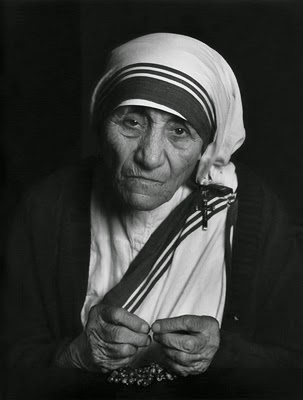
She goes on to write about the people who criticized her, hated her, and had nothing but contempt for her work; and yet, she rose above it all choosing to serve and love God in her weariness, her brokenness, her loneliness considering all life to be sacred from conception to death.
The author culminates the chapter by having us consider what is beauty -- is it these lovely to look at photos of famous people, or perhaps it is the face of Mother Teresa, filled with craggy wrinkles who shines as a brilliant blistering light showing us the way to truth. What did Jesus say..."If you have done it to the least of these, you have done it to me".
Friday, December 26, 2014
How to pray for the Dead

Those in purgatory cannot pray for themselves, this is why they are called “poor” souls. They can no longer merit anything for themselves and rely entirely on others to pray and make sacrifices on their behalf. As they are nevertheless part of the communion of saints, they depend upon us to help ease their suffering and quickly advance them through their purification so that they can join the saints in heaven.
Prayers for the faithful departed pleases God, who makes use of our prayers to help purify these souls that He loves. It is an act of charity that we can give for those we have known and loved, for our ancestors who gave us life, for those souls whose memory is lost, and for those who have no one else to pray for them.
Here are some ideas for praying for these suffering (and often neglected) souls, especially during the month of November dedicated to their memory:
1. Pray the Novena to the Holy Souls.
2. Offer up your Holy Communions for the souls in purgatory.
3. Have masses said for the dead.
4. Pray the Way of the Cross for souls in purgatory.
5. Pray the Holy Souls Rosary.
6. Obtain Indulgences.
7. Give alms.
8. Pray The Divine Mercy Chaplet.
9. Prayer of St. Gertrude the Great.
10.Sprinkle Holy Water on the ground.
11.When passing by or visiting a cemetery, pray the eternal rest prayer.
12.Practice the tradition of praying the eternal rest prayer before and after meals.
13.Visit a cemetery and pray for the departed souls, even if you do not know them.
14.Eucharistic Adoration: make reparation to the Sacred Heart of Jesus for those in purgatory.
15.Make sacrifices for the dead: practice acts of self-denial.
16.Pray the office of the dead.
17.Ask the intercession of the saints.
18.Repent and go to Confession.
19.Spread devotion to the holy souls.
20.Through-out your day, offer up special prayers.
Wednesday, December 24, 2014
Mom
My dear mother just died and my heart is broken. A little piece of me just died too. I took care of her 3 weeks prior to her death and had given her three kisses and a hug the last time I was with her. She died 7 hours later without me being there. No one was in the room with her. She died alone.
My mother would recite this sweet little poem to me when I was growing up and would even say it to me when I was grown. It goes like this, "Two pink eyed doves sitting in a tree. One for you (then she would kiss me on one of my eyelids), and one for me (she would then kiss me on the other eyelid)." It always made me feel loved and wanted.
One day I was looking out her bedroom window while she was sleeping and I saw two doves sitting in her Brazilian Floss Silk Tree. I went outside with my iphone and those birds just sat there while I took their picture -- posing for me. Here is the picture.

My mother would recite this sweet little poem to me when I was growing up and would even say it to me when I was grown. It goes like this, "Two pink eyed doves sitting in a tree. One for you (then she would kiss me on one of my eyelids), and one for me (she would then kiss me on the other eyelid)." It always made me feel loved and wanted.
One day I was looking out her bedroom window while she was sleeping and I saw two doves sitting in her Brazilian Floss Silk Tree. I went outside with my iphone and those birds just sat there while I took their picture -- posing for me. Here is the picture.

Friday, November 21, 2014
Culture of Death and the Dictatorship of Relativism

He talked about how we've come half circle in our thinking comparing what we are allowing in our society with what the Nazi's did in WWII; the next part he wrote in such a succinct way: "What Brittany Maynard's decision (to take her own life) clearly reveals are two of the great sins of our time: the sin of being inconvenient to others, and the sin of not being in control. She didn’t want to be an inconvenience to her family, to take care of her as her health deteriorated. Such a pity. She deprived them of the opportunity to recognize Christ in her sick, diseased form, the chance to minister to Him. Imagine if St Damien had had the same attitude towards the Hawaiian lepers, or Blessed Mother Teresa towards the outcasts in Calcutta. Perhaps her family isn’t Christian. At worse, if they are, they failed to understand the redemptive value of suffering. Instead, they allowed her to self-abort, because she defined herself as an inconvenience to others." He goes on to say that some people in our culture have promoted the idea that we have the right to take our own lives and that this is a sin as well. Even christians have embraced this belief which is entirely contrary to the gospel of Christ. We do not belong to ourselves but to God. https://actsoftheapostasy.wordpress.com/2014/11/03/brittany-maynard-and-the-sins-of-our-times/#comments
In regards to my title, " the Dictatorship of Relativism": I believe the reason people embrace this kind of thinking is that we are told that everything is "relative". If one says, "you have your truth and I have mine", may sound flexible and conciliatory, but it is entirely false. It might sound even reasonable except that it is really not reasonable at all. Our God said that there is only one truth -- not many truths and that He is truth. He has given us His Word and His Church to guide and lead us through life. He is our good shepherd and we must trust Him to guide us faithfully rather than embrace what sounds reasonable and compelling.
Wednesday, November 5, 2014
Watercolor of fishing boats

Here is the drawing I did first:

Wednesday, October 22, 2014
Pretend you are a Saint....

go here for penny catechism: http://www.proecclesia.com/penny%20catechism/index.htm
Monday, October 20, 2014
Did John write the gospel of John?

So, I went hunting for what the Catholic Church, in all her wisdom, teaches about this and found, not to my surprise, that John wrote the gospel of John. Here is an excerpt from Mark P. Shea, Catholic writer found on www.catholic.com:
The facts are these: The Tradition of the Church, supported by the unbroken line of patristic testimony, as well as internal evidence from the text itself, is that the Gospel is rooted in the testimony of the apostle John, son of Zebedee. Numerous other witnesses in the second and third centuries corroborate St. Irenaeus’s testimony. In addition, various elements within the Gospel strongly suggest John as the author. Most obviously, there is the attestation of the witnesses penning the Gospel that it is the testimony of "the disciple whom Jesus loved" (John 21:20)—a disciple to whom no one but John corresponds. The source of the Gospel is, quite clearly, a Jew familiar with the conditions of Palestinian Judaism at the time of Christ. He speaks Aramaic and Greek. He knows Jerusalem as it looked before Rome reduced it to rubble in A.D. 70. And he gives countless details which, if they are not the testimony of a first-hand eyewitness who was present at the Last Supper, are a singular occurrence of novelistic realism 19 centuries ahead of its time. That he was part of Christ’s "inner circle" of Peter, James, and John (cf. Gal. 2:9) is even more likely given that he was the disciple at the Last Supper who laid his head on Christ’s breast. He can’t be Peter, who is distinguished from him in the text, and he can’t be James (who died in the early 40s). So it all points to John. Additionally, the patristic tradition that the Gospel was composed in Ephesus also points to John. First, this is the city associated with the Assumption of the Virgin who was commended into his care. Second, the Gospel repeatedly answers a sect devoted to John the Baptist with the reply that John "was not the light" but had only come to "bear witness to the light" (John 1:8). We know from Acts 18:24 and 19:1-7 that there was such a sect centered in Ephesus. Finally, the sophistication of the Gospel fits the fact that the New Testament epistle with the most sophisticated exposition of theology is Ephesians.
So all the evidence points to the accuracy of the Church’s tradition that John published his Gospel in Ephesus in the second half of the first century.
There is more-- but, you'll have to go to the weblink to read it, and it is worth reading: http://www.catholic.com/magazine/articles/did-john-write-his-gospel
Another issue, just as problematic, is should I talk to this priest about teaching controversial and erroneous things from the pulpit? or should I just forget about it? I don't know.
Friday, October 17, 2014
St. Francis spoke to the Sultan

St. Francis was a man of action. He took a trip to Damietta, Egypt in 1219, during the Fifth Crusade to either convert the (Muslim) Sultan, Malik al-Kamil, to Christ or be martyred trying. He, along with his traveling companion Brother Illuminato, were dispatched by Pope Honorius IV in 1219. According to his biographer, his intention was to convert the Sultan, not have an "open" and congenial discussion. After Francis and Illuminato had been captured, threatened with decapitation, and then led into the presence of the sultan, he promptly asked Francis if he wished to become a Saracen (Muslim). Francis responded he did not come to convert to the religion of Mohammed, but instead had come to present the sultan’s soul to God on behalf of Christ. After consulting with his advisers, it was determined that the brothers were to be beheaded according to their law. However, because the Sultan liked St. Francis he gave him his freedom and had his guards escort him back to the Christian camp. He offered St. Francis gold, silver, and precious cloth, but he refused it all saying that the only precious thing he could have taken to God was the Sultan's soul.
Monday, October 6, 2014
Giving it up!

http://www.blossomingjoy.com/blog/stopomg
Try this instead...
Blessed be God.
Blessed be His Holy Name.
Blessed be Jesus Christ, true God and true Man.
Blessed be the Name of Jesus.
Blessed be His Most Sacred Heart.
Blessed be His Most Precious Blood.
Blessed be Jesus in the Most Holy Sacrament of the Altar.
Blessed be the Holy Spirit, the Paraclete.
Blessed be the great Mother of God, Mary most Holy.
Blessed be her Holy and Immaculate Conception.
Blessed be her Glorious Assumption.
Blessed be the name of Mary, Virgin and Mother.
Blessed be St. Joseph, her most chaste spouse.
Blessed be God in His Angels and in His Saints.
Amen.
* * *
Monday, September 22, 2014
Fr. Peirre Teillard de Chardin

Some of Teilhard de Chardin's ideas came into conflict with some officials in the Roman Curia and in his own Jesuit order. Specifically, Teilhard's superiors thought that Teilhard's views on original sin were contrary to Catholic doctrine. As a result, many of Teilhard's writings were censored by the Church during his lifetime. However, in July 2009, Vatican spokesman Fr. Federico Lombardi said: "By now, no one would dream of saying that [Teilhard] is a heterodox author who should not be studied."(http://ncronline.org/news/pope-cites-teilhardian-vision-cosmos-living-host) And, although his writings brought some controversy, his reflections on the nature of goodness and of the meaning of Jesus Christ has received praise from figures such as Pope Benedict.
Many of the concepts he writes about are confusing and seem to conflict with Catholic teaching, like "noosphere": For Teilhard, the noosphere is the sphere of thought encircling the earth that has emerged through evolution as a consequence of this growth in complexity / consciousness. The noosphere is therefore as much part of nature as the barysphere, lithosphere, hydrosphere, atmosphere and biosphere. As a result, Teilhard sees the "social phenomenon [as] the culmination of and not the attenuation of the biological phenomenon."[8] These social phenomena are part of the noosphere and include, for example, legal, educational, religious, research, industrial and technological systems. In this sense, the noosphere emerges through and is constituted by the interaction of human minds. The noosphere thus grows in step with the organization of the human mass in relation to itself as it populates the earth. Teilhard argued the noosphere evolves towards ever greater personlisation, individuation and unification of its elements. He saw the Christian notion of love as being the principal driver of noogenesis. Evolution would culminate in the Omega Point - an apex of thought/consciousness - which he identified with the eschatological return of Christ.
Wednesday, September 17, 2014

Sunday, September 14, 2014

Saturday, August 30, 2014
The Chained Goldfinch
Fabritius is generally considered Rembrandt's most gifted pupil and a painter of outstanding originality and distinction, but he died tragically young in the explosion of the Delft gunpowder magazine, leaving only a tiny body of work. Of all Rembrandt's pupils, Fabritius was the only one to develop his own artistic style. Fabritius' portraits feature delicately lit subjects against light-colored, textured backgrounds. He became interested in the technical aspects of painting. He used cool color harmonies to create shape in a luminous style of painting.
This very small painting on a panel measuring 13"x 9" is of a chained golfinch and one of only a handful of paintings to survive down the ages. Against a luminous, whitewashed wall—a hallmark of the Delft school but here marked by crumbling plasterwork and patches of scumbled, slate-blue priming—Fabritius paints to scale a common goldfinch tethered by a delicate metal chain. The artist's name and the date at the lower edge appear not painted but incised into the same blue-gray ground, and the color is repeated in the square feedbox at center, in cast shadows, in underpainting on the circular wooden rungs, and in the bird's soft down. The composition is elegant in its spare simplicity: Only the goldfinch and its shadow offset the subtle balance of hard edges and swagging curves that create its perfect symmetry.
The slope of the box, the slanted shade, and the steep angle at which we see the bird suggest that Fabritius intended his small painting to be hung high and viewed at a slight distance, the vantage point at which its captured illusion of a tiny creature peering down from its perch is most convincing. The painter draws us near, however, with the dazzling virtuosity of his brushwork. Strokes of paint remain perceptible on the surface and range from veils of thin pigment and soft swirls of darkened reds to crusted threads of glistening white impasto.
Apparently, the goldfinch was a favorite pet in Dutch homes and is often seen depicted in Dutch paintings. The goldfinch had also figured in countless devotional images as a symbol of death and resurrection, its small spot of red plumage an allusion to Christ's passion.
http://online.wsj.com/news/articles/SB10001424052748704483004575524242638692182

This very small painting on a panel measuring 13"x 9" is of a chained golfinch and one of only a handful of paintings to survive down the ages. Against a luminous, whitewashed wall—a hallmark of the Delft school but here marked by crumbling plasterwork and patches of scumbled, slate-blue priming—Fabritius paints to scale a common goldfinch tethered by a delicate metal chain. The artist's name and the date at the lower edge appear not painted but incised into the same blue-gray ground, and the color is repeated in the square feedbox at center, in cast shadows, in underpainting on the circular wooden rungs, and in the bird's soft down. The composition is elegant in its spare simplicity: Only the goldfinch and its shadow offset the subtle balance of hard edges and swagging curves that create its perfect symmetry.
The slope of the box, the slanted shade, and the steep angle at which we see the bird suggest that Fabritius intended his small painting to be hung high and viewed at a slight distance, the vantage point at which its captured illusion of a tiny creature peering down from its perch is most convincing. The painter draws us near, however, with the dazzling virtuosity of his brushwork. Strokes of paint remain perceptible on the surface and range from veils of thin pigment and soft swirls of darkened reds to crusted threads of glistening white impasto.
Apparently, the goldfinch was a favorite pet in Dutch homes and is often seen depicted in Dutch paintings. The goldfinch had also figured in countless devotional images as a symbol of death and resurrection, its small spot of red plumage an allusion to Christ's passion.
http://online.wsj.com/news/articles/SB10001424052748704483004575524242638692182

Sunday, August 24, 2014
Saturday, August 23, 2014
Wednesday, August 20, 2014
Our Lady of Good Remedy

This is one of my very favorite go to prayers. I cannot tell you how many times my prayers have been answered in a miraculous way by Our dear Mother.
Saturday, August 16, 2014
The Litany of Humility

O Jesus meek and humble of heart, Hear me.
From the desire of being esteemed, Deliver me, Jesus.
From the desire of being loved, Deliver me, Jesus.
From the desire of being extolled, Deliver me, Jesus.
From the desire of being honored, Deliver me, Jesus.
From the desire of being praised, Deliver me, Jesus.
From the desire of being preferred to others, Deliver me, Jesus.
From the desire of being consulted, Deliver me, Jesus.
From the desire of being approved, Deliver me, Jesus.
From the fear of being humiliated, Deliver me, Jesus.
From the fear of being despised, Deliver me, Jesus.
From the fear of suffering rebukes, Deliver me, Jesus.
From the fear of being calumniated, Deliver me, Jesus.
From the fear of being forgotten, Deliver me, Jesus.
From the fear of being ridiculed, Deliver me, Jesus.
From the fear of being wronged, Deliver me, Jesus.
From the fear of being suspected, Deliver me, Jesus.
That others may be loved more than I,
Jesus, grant me the grace to desire it.
That others may be esteemed more than I,
Jesus, grant me the grace to desire it.
That in the opinion of the world, others may increase, and I may decrease,
Jesus, grant me the grace to desire it.
That others may be chosen and I set aside,
Jesus, grant me the grace to desire it.
That others may be praised and I unnoticed,
Jesus, grant me the grace to desire it.
That others may be preferred to me in everything,
Jesus, grant me the grace to desire it.
That others may become holier than I, provided that I become as holy as I should,
Jesus, grant me the grace to desire it. (by Rafael Cardinal Merry del Val)
Friday, August 15, 2014
Art is not what you see.....
Edgar Degas said, "Art is not what you see, but what you make others see." Just came across this wonderfully talented artist, Anne-France Fulgence. Her work is beautiful; it's poetry.


Thursday, August 14, 2014
Greater Love has no man than this.....
John 15:12-17
12) "This is my commandment, that you love one another as I have loved you. 13) Greater love has no man than this, that a man lay down his life for his friends. 14) You are my friends if you do what I command you. 15) No longer do I call you servants, for the servant does not know what his master is doing; but I have called you friends, for all that I have heard from my Father I have made known to you. 16) You did not choose me, but I chose you and appointed you that you should go and bear fruit and that your fruit should abide; so that whatever you ask the Father in my name, he may give it to you. 17) This I command you, to love one another.
12) "This is my commandment, that you love one another as I have loved you. 13) Greater love has no man than this, that a man lay down his life for his friends. 14) You are my friends if you do what I command you. 15) No longer do I call you servants, for the servant does not know what his master is doing; but I have called you friends, for all that I have heard from my Father I have made known to you. 16) You did not choose me, but I chose you and appointed you that you should go and bear fruit and that your fruit should abide; so that whatever you ask the Father in my name, he may give it to you. 17) This I command you, to love one another.
Wednesday, August 13, 2014
Beauty without virtue
“Beauty without virtue is like a fair flower that has an offensive odor. But true beauty bathes in that light without which nothing is beautiful. Beauty is a gift of God, like the rain. He allows the rain to fall upon the just and the wicked, and He gives beauty not only to the good, but even to the wicked. Wicked beauty strikes the eye, but the inner beauty of grace wins the soul.” Archbishop Fulton Sheen (Guide to Contentment)Archbishop Fulton Sheen.


Tuesday, August 12, 2014
Monday, August 11, 2014
Hero
This is one of my grand-sons pretending to smoke Papa's pipe -- it may not be PC, but it is so darn cute!


Monday, August 4, 2014
Clouds
I don't know what it is about clouds, but I find them so fascinating. They are at once seemingly substantial and yet ephemeral. They are so beautiful -- I want to paint this pic of clouds. Will post if it comes out well.


Sunday, August 3, 2014
Subscribe to:
Posts (Atom)