

Friday, January 22, 2021
The Salesian Option


Wednesday, September 23, 2020
God's little creatures
I saw this on pinterest and read the story about the bees showing reverence for Holy Icons and wanted to share: here is the history
By Monk Simon In the region of Kapandriti near Athens, a wonderful thing happens. Ten years ago, a devout beekeeper named Isidoros Ţiminis, thought to place in one of his hives an icon of the Crucifixion of the Lord. Soon thereafter, when he opened the hive, he was amazed that the bees showed respect and devotion to the icon, having "embroidered" it in wax, yet leaving uncovered the face and body of the Lord. Since then, every spring, he puts into the hives icons of the Savior, the Virgin Mary and the Saints, and the result is always the same. Once I brought a handmade icon from a convent, that represented Golgotha with three crosses. Bees "embroidered" with wax the entire surface of the composition, leaving one to clearly perceive the Cross of Christ and the Thief at his right hand while the thief on the left cross was covered with a thick layer of wax. Last time I went, we put in an icon of St. Stephen the Proto-Martyr and Archdeacon, whose name our humble publishing company bears. As you can see from the picture that we publish here, the entire icon is clothed in beeswax, leaving uncovered his face and body. Source: The Saint's Love For Animals and the Animal's Love For the Saints. Translated by John Sanidopoulos.

Saturday, September 5, 2020

Friday, September 4, 2020

Wednesday, June 24, 2020
The Cloistered Heart
I just discovered that the blogger Nancy Shuman of the Cloistered Heart died in 2017. Her blog is still worth visiting. There is so much wisdom and spiritual direction to be found:


Sunday, May 10, 2020
A new Priest embraces his mother

After ordination, a priest's hands are consecrated with holy chrism and a manutergium is used to wipe the sacred oil from his hands. Since the chrism has been blessed by a bishop, it cannot be thrown in the trash or washed by normal means. Instead, an ancient and pious tradition continues by the priest giving his mother the manutergium. Tradition states:
When she arrives to the gates of heaven she is escorted directly to our Lord. Our Lord says to the woman – “I have given you life, what have you given to me?'” She hands him the manutergium and responds, “I have given you my son as a priest.” At this, Jesus grants her entry into paradise.
For the father, a recent tradition states that a priest will give his father his stole that was used for his first confession, indicating that fathers are instrumental in forming good men before they become priests.
What does this tell us? It tells us that the family is indeed the foundation of society and is rightfully called, "the Domestic Church" where vocations are born and cultivated through the pursuit of holiness.
Friday, April 10, 2020
In Sinu Jesu

Christians often forget the depth of God’s love as presented to us in Jesus Christ. He told his Apostles, and tells us today, “That to see me, is to see the Father”. It is a hard reality to grasp. It is for me. All the years as a monk I have struggled with this central mystery of Christ Jesus’s revelation of the Father’s love for each of us. It is because my heart is protected. I fear the pain that love brings, yet I seek to dive more deeply into it. So there is an inner contradiction that I experience that can only be healed by the grace of the Father’s burning love. There is a standing invitation to allow ourselves to be drawn into the eternal dance of the ‘Holy Trinity’, which will never be withdrawn from God’s side.
The paradox to this is that in order to fully allow God’s love to embrace me, I have to grow in the understanding of my inner-self and the often not so beautiful aspect of that. I can be fearful, that leads to anger, which at bottom, anxiety is feeding it all. I am 69 years old and at this stage of my life, finally starting to open up and to trust in God love for me. It has taken many self-inflicted wounds, the experiencing of my own self-hatred, and alienation, that has slowly healed me.
For in my darkest hour, when filled with my own misery and isolation, the light of God’s love has always broken through. I have accepted the fact that I am pursued by God, and that God will never let me go. Yet I am free and have had to make a choice to trust even when drowning in my own misery. For it is all lies, that I am beyond help, or healing, or mercy. We are all vessels of God’s love and each of us is called to allow Christ Jesus to incarnate in each of us. Our capacity to receive God’s love grows as we continue to grow in love and trust. When I pray I now feel my connection to every human being who are on their journey towards healing and deeper intimacy with God, for we are all one in Christ Jesus.
In the book “In Sinu Jesu”, Jesus speaks to a Benedictine Monk of his love for each of us, and in a special way, for the priest, and how that love is manifested in his abiding presence in the Holy Eucharist. As a Catholic, I can take the reality of Christ Jesus’s Eucharistic presence for granted. This book can open up anyone’s heart to the infinite depth of God’s love for each of us, without exception.
Karl Rahner stated that ‘private revelations’, are given to the church at different points in time because it is needed. It is not a new revelation but stated in terms that can be understood by people in certain eras. Today, love has seemed to have grown cold, or colder. So we need to be reminded of the Fathers infinite love for each of us.
On Tuesday, January 26th, 20 10 (pg. 139) Jesus relayed this message to the Benedictine monk:
“Do you not see how much I have been calling you to trust in me? Trust is the key that opens all the treasures of My merciful and infinitely loving Heart. I am touched by a single act of trust in My merciful love more than by a multitude of good works. The soul who trusts in Me allows Me to work freely in her life. The soul who trust Me, by that very fact removes the obstacles of pride and self-determination that impede My freedom of action. There is nothing I will not do for the soul who abandons herself to me in a simple act of trust”.
Either ‘fear’ or ‘trust’ is growing in the soul. The more we love, fear will lessen. The opposite is also true. The more we believe ‘fear’, then ‘trust’ will weaken. Fear is a form of self-absorption, trust is letting go of being overly concerned about one’s self and seeking to grow deeper in intimacy with the beloved.
As Christian we are called to be lovers, to show forth Christ infinite love for all. When that is forgotten, then fear, and anxiety, and anger will come to the fore. That is how we protect ourselves from others, we place barriers. It is only by the healing of our inner defenses, which we receive through Jesus Christ, that we can let go of fear. It is not something we can do on our own, yet we can make a free choice to trust and in that God’s healing love will flow through us.
There is nothing that can stop God loving us, yet we can choose to turn our backs on that reality. Each day is a new beginning. Each moment even. For no matter where we find ourselves, there is always a way out through the merciful love of Christ Jesus. We stop being victims and can step forward in hope and faith and love. –Br.MD (Mark Dohle)
Tuesday, December 17, 2019
O Sovereign and true leader...

O Sovereign and true leader, O Christ, my King,
I kneel before Thee here like a vassal in the old feudal times
to take my oath of fealty.
I place my joined hands within Thy wounded hands and promise Thee inviolable loyalty.
I dedicate to Thee all the powers of my soul,
all the senses of my body,
and all the affections of my heart.
Take, O Lord, all my liberty.
Receive my memory, my understanding, and my whole will.
All that I am, all that I have, Thou hast given me, and
I restore it all to Thee, to be disposed of according to Thy good pleasure.
Give me only Thy love and Thy grace;
with these I am rich enough, and desire nothing more. Fr. Lasance Missal
I will kneel before the altar of God.
I will receive my King upon my tongue.
I will offer my oath of fealty in coin
and candleflame...
(Stefanie Nicholas)
Friday, March 8, 2019
Look down upon me....

"Look down upon me, good and gentle Jesus." "Look down upon me, good and gentle Jesus, while before your face I humbly kneel, and with burning soul pray and beseech you to fix deep in my heart lively sentiments of faith, hope and charity, true contrition for my sins, and a firm purpose of amendment, while I contemplate with great love and tender pity your five wounds, pondering over them within me, calling to mind the words which David, your prophet, said of you, my good Jesus: "They have pierced my hands and my feet; they have numbered all my bones." PLENARY INDULGENCE when recited on a Friday in Lent and Passiontide, when recited after Communion before an image of Christ crucified. On any other day the indulgence is partial.
THE CROWN OF THORNS

MEDITATIONS FOR LENT FROM ST. THOMAS AQUINAS
FRIDAY AFTER ASH WEDNESDAY: THE CROWN OF THORNS
Go forth, ye daughters of Sion, and see king Solomon in the diadem, wherewith his mother crowned him in the day of his espousals, and in the day of the joy of his heart. (Cant 3:5).
This is the voice of the Church inviting the souls of the faithful to behold the marvellous beauty of her Spouse. For the daughters of Sion, who are they but the daughters of Jerusalem, holy souls, the citizens of that city which is above, who with the angels enjoy the peace that knows no end, and, in consequence, look upon the glory of the Lord?
1. Go forth, shake off the disturbing commerce of this world so that, with minds set free, you may be able to contemplate Him whom you love. And see king Solomon, the true peacemaker, that is to say, Christ Our Lord.
In the diadem wherewith His mother crowned Him, as though the Church said, "Look on Christ garbed with flesh for us, the flesh He took from the flesh of His mother." For it is His flesh that is here called a diadem, the flesh which Christ assumed for us, the flesh in which He died and destroyed the reign of death, the flesh in which, rising once again, He brought to us the hope of resurrection.
This is the diadem of which St. Paul speaks, We see Jesus for the suffering of death crowned with glory and honour (Heb 2:9). His mother is spoken of as crowning Him because Mary the Virgin it was who from her own flesh gave Him flesh.
In the day of His espousals, that is, in the hour of His Incarnation, when He took to Himself the Church not having spot or wrinkle (Eph 5:27), the hour again when God was joined with man. And in the day of the joy of His heart. For the joy and the gaiety of Christ is for the human race salvation and redemption. And coming home, He calls together His friends and neighbours saying to them, Rejoice with me, because I have found my sheep that was lost (Luke 15:6).
2. We can however refer the whole of this text simply and literally to the Passion of Christ. For Solomon, foreseeing through the centuries the Passion of Christ, was uttering a warning for the daughters of Sion, that is, for the Jewish people.
Go forth and see king Solomon, that is, Christ, in His diadem, that is to say, the crown of thorns with which His mother the Synagogue has crowned him; in the day of His espousals, the day when He joined to Himself the Church; and in the day of the joy of His heart, the day in which He rejoiced that by His Passion He was delivering the world from the power of the devil. Go forth, therefore, and leave behind the darkness of unbelief, and see, understand with your minds that He who suffers as man is really God.
Go forth, beyond the gates of your city, that you may see Him, on Mount Calvary, crucified.
Saturday, March 2, 2019
Lectio Divina

Here is the method:
* Choose a quiet spot alone to pray.
* Focus your mind and heart on God.
* Ask the Holy Spirit to speak to you through the Scriptures.
* Begin prayerfully reading your chosen passage.
* When anything moves you, pause. Ponder. Talk to God about what you have read, praise Him, or silently lift your heart to Him in love–whichever
you feel moved to do.
* When your conversation with God dries up, return to your passage.
* Repeat steps 5 and 6 until your time is almost ended.
* End with the Our Father, another vocal prayer of your choice, or a brief word of thanksgiving.
Saturday, February 9, 2019
When does Tolerance become Tyranny?

Nobody wants to dispute the fact that tolerance is a virtue, and nobody wants to argue for intolerance, however, there does need to be an ordering of virtue. Tolerance is too often mistaken for charity, and having good manners is too often mistaken for being good. Real goodness, like real charity is tough love because real goodness, like real charity, loves the truth and the truth hurts. (please read this article by Fr. Longnecker. It is really good and helps with one's thinking clearly.)
http://www.ncregister.com/blog/longenecker/the-tightrope-of-tolerance-and-tyranny
Monday, February 4, 2019
O Sacred Heart of Jesus

Take away, O my Jesus, the blindness of my heart, that I may know Thee; take away the hardness of my heart, that I may fear Thee; take away the coldness of my heart, that I may resist everything that is contrary to Thy will; take away its heavy, earthly sluggishness and selfishness, that I may be capable of heroic sacrifice for Thy glory, and for the souls whom Thou has redeemed with Thy own most precious blood. Amen.
Thursday, December 27, 2018
Wednesday, October 3, 2018
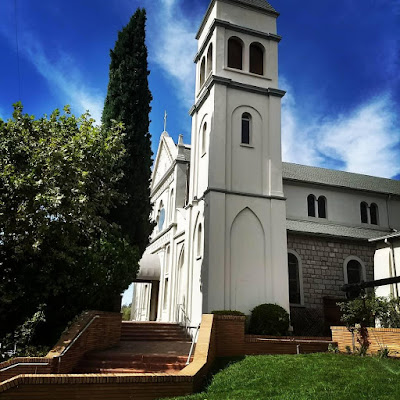
Vintage St. Joseph's Catholic Church
Here are photos of the original St. Joseph's built in 1911. It was a beautiful space. I know the people who "updated" the interior thought they were doing a good thing. But, I love the old space better:


St. Joseph's Catholic Church - stained glass windows
Don't you love stained glass windows in a church? They not only bring beauty and light into the sanctuary, but teach as well. Here are some of the stained glass windows at St. Joseph's in Auburn:


St. Joseph's Catholic Church
I love this little church in the foothills east of Sacramento. Our daughter was married there. We attended catechism classes there and were confirmed in the faith. I would love to see this church restored to its original.




Wednesday, April 18, 2018
St. Thomas - a little known history

THE APOSTLE ST. THOMAS ON THE AMERICAN CONTINENT
by Father P. De Roo, 1899
The belief that ... [the Apostle] St. Thomas penetrated as far as America, in the desire to propagate the teaching of Jesus Christ, is not devoid of foundation. ...[T]he old American traditions, so singularly consistent by their agreement, whilst originating in many different parts of this extensive continent, cannot be [lightly dismissed]. St. Thomas ... had not [here] lasting success..., but other Catholic missionaries followed in the course of time to renew the work, and to teach Catholic doctrine, morality, and worship, of which the Spaniards found so many clear vestiges in South America at the time of its discovery and conquest.
But, you may ask, how did he get to the Americas in order to evangelize them;[We should then by no means rule out the possibility] of a miraculous intervention of God for the purpose of spreading the true Faith.... [Let us consider] some prehistoric vestiges found in America, that would seem to indicate the actual presence of the Apostle St. Thomas on this continent.
It is especially amongst the oldest nations of Brazil that the memory of the Apostle has been religiously kept, ...preserv[ing] the tradition that he preached to them. Nieremberg (Historiae Naturae, l. xiv, c. cxvii) writes: "The East Indians [i.e., those of Brazil] still show a path followed by St. Thomas on his way to the kingdoms of Peru. ... It is related in particular that St. Thomas had gone to Paraguay (See Nieremberg, loc. cit., and Bancroft, Native Races, vol. V, p 26) along the Iguazu River; and afterwards to Parana on the Uruguay, on the bank of which is pointed out a spot where he sat down to rest. According to the ancient reports he foretold the later coming of men who would announce to their descendants the faith of the true God. This tradition is indeed a great consolation and encouragement to the preachers of our holy religion who suffer much in their labors for the faith among those barbarous nations." ... [A]nyone reading the chronicles of Brazil...must be impressed with the fact that in that country, down from ancient times, ...the name of St. Thomas, who preached there, is preserved. ...
[Concerning the above reference] stat[ing] that St. Thomas entered Paraguay and the neighboring provinces..., Sahagun (Historia General, p. iv) relates that the Commissary of the Franciscans, who, with four other religious, had been sent to La Plata, wrote on the first of May, 1533, ...a most remarkable letter, in which he states that the Christians had been received like angels by the natives, from whom he had learned that, four years before, a certain prophet...had announced to them that ere long Christians, brothers of St. Thomas, would come to baptize [them].... [T]he prophet...had [further] enjoined them to keep the Commandments and many other Christian teachings. This report is hardly more surprising than [what we learn] from the History of Paraguay by Charlevoix...: When, in the year 1609, the Fathers Cataldino and Moceta penetrated into the wilderness of America, to convert the Guaranis, [certain] chiefs of the tribe assured them that long ago, according to their ancestral traditions, a learned man, named Pay Zuma or Pay Tuma, had preached in their country the faith of heaven and had made many conversions amongst them. Yet, in leaving he had foretold them that they and their descendants would abandon the worship of the true God, whom he had made known to them; but that, after the lapse of centuries other messengers of the same God would come with a cross, like the one they saw him carrying, and would restore among their posterity the faith he was preaching. Some years later, when Fathers Montoya and Mendoza were in the district of Taiati, in the province of Santa Crux, the Indians, seeing them approach with crosses in their hands, received them with great demonstrations of joy. The missionaries, manifesting their astonishment, were told the same story as was told Cataldino and Moceta. These natives designated their ancient Apostle also by the name of Pay Abara, or the Celibate Father. Pay Zuma seems, however, to have been the more common appellation. In all these regions the first Christian missionaries of the sixteenth century were called Pay-zumas, by the aborigines (cf. Horn, De Originibus Americanis, l. 3, c. 19; and Bastian, Die Culturländer des Alten Amerika, b. II, s. 58-67). ... It will be noticed that [the form Zuma or Tuma] bears a striking resemblance to the Apostle's name. ...
Traditions similar to these are reported in other parts of South America, such as those of the Tupinambas, and along the Uruguay, where is shown still the resting-place of the Apostle during his sojourn among the tribe (Nieremberg, loc. cit.). ...
The most ancient traditions of the Peruvians tell of a white-bearded man, named "Thonapa Arnava," ...who arrived in Peru from a southern direction, clothed with a long violet garment and red mantle. He taught the people to worship ... the Supreme God and Creator, instead of the sun and moon; [he] healed the sick and restored sight to the blind. At his approach, wherever he went, the demons took to flight. ... Horn aptly remarks that proper names frequently undergo slight variations in their passage from language to language, so that Thonapa might easily represent Thoma-Papas. ... [The title Papas, or Father, is] evidently imported, as it is without meaning in the native tongue.... The surname "Arnava" is not unreasonably interpreted from the Peruvian Nechua dialect, in which arma or arna signifies to bathe or pour water, referring probably to the ceremonies of baptism administered by St. Thomas...; [thus the name seems to designate him as Father] Thomas the Baptist. Sahagun tells the curious fact that the Peruvians gave to their missionaries, after the Spanish conquest, the name of ... Padres Tomés.
The Chilians likewise have a tradition of a bearded and shod man, who had appeared to their forefathers, healing the sick and procuring for them, when their land was parched, abundant rains (Bastian, loc.cit.).
[Concerning] the northern half of our continent..., we find in one of [America's] most magnificent ruins, in the temple of the cross of Palenque, artistic relics, which many learned antiquarians have considered as unmistakable records of the early possession of the Catholic faith. ...
Sahagun...assures us that the famous Mexican high priest and civilizer, Quetzalcoatl, was none other than St. Thomas. "Cohuatl," he says, means not serpent, as it is often mistranslated, but "twin," that is, the name of the Apostle, who was called Didumos, which means "twin"; an interpretation confirmed by the fact that in Mexico there was no serpent-worship, and no serpent is represented on any altar. ... Bancroft (Ibid., vol. V, p 200) ... says: "During the Olmec period, that is, the earliest periods of Nahua power, the great Quetzalcoatl appeared. His teachings, according to the traditions, had much in common with those of Christ in the Old World; and most of the Spanish writers firmly believed him to be identical with one of the Christian Apostles, probably St. Thomas."
Thus the belief that ... [the Apostle] St. Thomas penetrated as far as America, in the desire to propagate the teaching of Jesus Christ, is not devoid of foundation. ...[T]he old American traditions, so singularly consistent by their agreement, whilst originating in many different parts of this extensive continent, cannot be [lightly dismissed]. St. Thomas ... had not [here] lasting success..., but other Catholic missionaries followed in the course of time to renew the work, and to teach Catholic doctrine, morality, and worship, of which the Spaniards found so many clear vestiges in South America at the time of its discovery and conquest.
It would not, therefore, have been such an extraordinary matter to have followed these nations in their migrations eastward to Polynesia, and even as far as the Americas. ... But suppose that, for the sake of argument, it be granted that human means of transportation from Palestine or from European coasts to America were unknown during the lifetime of the Apostle....
There are records to indicate that St. Thomas travelled through [regions of the ancient Near East such as] Parthia, Media, Persia, Hircania, and Bactria, and thence proceeded further east to India proper (Roman Breviary, Dec. 21). Greek-speaking Christian congregations still exist at Socotera [the island Socotra, in the Indian Ocean], the place in which the missionary Theophilus was preaching at the time of Emperor Constantine. It is well known that an entire Christian population was found here by Kosmas Indicopleustes in the sixth century, by Arabian freighters in the ninth, and finally by the Portuguese in the year 1507. According to the traditions of the Syrian Christians, the Apostle passed by Socotera and landed at Cranganor, where took place the first conversions of the Indian people. He established Christian communities all over the coasts of Coromandel and Malabar, until he shed his blood for the doctrine he was preaching -- in a place, since called Beit-Tuma, or house of Thomas. This tradition is related by St. Gregory of Nazianzen, and by a merchant of Alexandria who found Christians also in Ceylon (Peschel: Geschichte des Zeitalters der Entdeckungen, S. 5). Nicephorus, of Constantinople, and nearly all the authors referred to by Solorzano, state, moreover, that St. Thomas preached [not only] to the easternmost peoples of India, [but even to] the Chinese.
(Rev. P. De Roo, "The Apostle St. Thomas in America," American Ecclesiastical Review, vol. XX, Jan., 1899)
Tuesday, April 10, 2018
Are my sins really that bad?

"In his act of self-sacrifice on the cross, the fathers argued, Jesus lured the dark powers into the open and away from the human beings who had been in their thrall." excerpt from, The Most Unexpectedly religious film of the year, by Bishop Robert Barron.
After reading Bishop Barron's commentary on The Quiet Place, 2018, my mind began wondering over the father's self sacrifice to save his children and how this could be compared to God the Father's plan for humanity in the sacrifice of his only begotten son, Jesus; and I thought to myself....does anyone today think their sins are so bad they should die because of them? Most people I talk to have a pretty good opinion of themselves and when confronted with the reality of their sins will say, "I just ask God to forgive me and He does".
Okay, that is all very well and good, but what about the sin committed? Was it so bad that one should die because of the sin? Personally, I think we have collectively all gone far afield of what God thinks of sin - immoral acts; and, perhaps we really don't understand how devastating sin is in our lives. It is too easy in this modern culture to be distracted, look the other way, deliberately forget about the sin. Therefore, we never truly develop a sense of mortification for our deeds that so displease God.
So, what does that do in regards to the great sacrifice of God's son, Jesus? It seems logical to think that if one does not think one's sins are really all that bad, and certainly not bad enough to die for, then Christ's sacrifice isn't......well, you know where that leads. Heaven forbid that our hearts should be so hardened that we are not truly cut the marrow of our souls each time we sin. Pray for these things that you might have a tender heart: mortification of spirit, habitual contrition through the gift of compunction, for tears of sorrow for our sins, for the grace to pray well, for perseverance, for docility toward the Holy Spirit, for discernment of spirits, and finally for the gift to distrust oneself. Do not place any confidence in yourselves, but in God alone.
Saturday, March 17, 2018
Feminine Heroines
I have been listening to a podcast by Leanne Van der Putten, a catholic wife, mother, and grandmother, who has a blog called Finer Femininity and want to recommend it to all my friends and family. She really speaks to me and is helping me in my walk with Christ. Here is a link to the podcast on youtube:
https://www.youtube.com/watch?v=-gCENl4pq8g&t=552s
https://www.youtube.com/watch?v=-gCENl4pq8g&t=552s
Sunday, February 11, 2018
Wednesday, January 24, 2018
Wednesday, January 17, 2018
La Petite Jardiniere

This is what we are about: We plant the seeds that one day will grow. We water seeds already planted, knowing that they hold future promise." | Archbishop Oscar Romero
Gardening Daniel Ridgway Knight (American-born French genre painter, 1839-1924) la petite jardiniere
God's call to Beauty - Woman

...in the heart that is open to kindness
...in a mind which seeks after wisdom
...in a heart that is faithful through suffering
...in a whole presence that is full of graciousness and a strength that comes from within.
To be a woman is to say in many different ways and yet in all uniqueness:
I am beautiful before God
I am beautiful before man
and beautiful before children
when I am most truly woman.
https://www.themotherscloister.com/journal/2017/10/23/beautiful-is-the-woman
Tuesday, October 3, 2017
Friday, September 29, 2017
St. Michael oro pro nobis

The Chaplet of St. Michael is a wonderful way to honor this great Archangel along with the other nine Choirs of Angels. What do we mean by Choirs? It seems that God has created various orders of Angels. Sacred Scripture distinguishes nine such groupings: Seraphim, Cherubim, Thrones, Dominations, Powers, Virtues, Principalities, Archangels and Angels (Isa. 6:2; Gen. 3:24; Col. 1:16; Eph. 1:21; Rom. 8:38). There may be more groupings but these are the only ones that have been revealed to us. The Seraphim is believed to be the highest Choir, the most intimately united to God, while the Angelic Choir is the lowest.
The history of this Chaplet goes back to a devout Servant of God, Antonia d'Astonac, who had a vision of St. Michael. He told Antonia to honor him by nine salutations to the nine Choirs of Angels. St. Michael promised that whoever would practice this devotion in his honor would have, when approaching Holy Communion, an escort of nine angels chosen from each of the nine Choirs. In addition, for those who would recite the Chaplet daily, he promised his continual assistance and that of all the holy angels during life, and after death deliverance from purgatory for themselves and their relations.
The Chaplet of St. Michael
O God, come to my assistance. O Lord, make haste to help me. Glory be to the Father, etc.
[Say one Our Father and three Hail Marys after each of the following nine salutations in honor of the nine Choirs of Angels]
1. By the intercession of St. Michael and the celestial Choir of Seraphim may the Lord make us worthy to burn with the fire of perfect charity.
Amen.
2. By the intercession of St. Michael and the celestial Choir of Cherubim may the Lord grant us the grace to leave the ways of sin and run in the paths of Christian perfection.
Amen.
3. By the intercession of St. Michael and the celestial Choir of Thrones may the Lord infuse into our hearts a true and sincere spirit of humility.
Amen.
4. By the intercession of St. Michael and the celestial Choir of Dominations may the Lord give us grace to govern our senses and overcome any unruly passions.
Amen.
5. By the intercession of St. Michael and the celestial Choir of Virtues may the Lord preserve us from evil and falling into temptation. Amen.
6. By the intercession of St. Michael and the celestial Choir of Powers may the Lord protect our souls against the snares and temptations of the devil.
Amen.
7. By the intercession of St. Michael and the celestial Choir of Principalities may God fill our souls with a true spirit of obedience. Amen.
8. By the intercession of St. Michael and the celestial Choir of Archangels may the Lord give us perseverance in faith and in all good works in order that we may attain the glory of Heaven.
Amen.
9. By the intercession of St. Michael and the celestial Choir of Angels may the Lord grant us to be protected by them in this mortal life and conducted in the life to come to Heaven.
Amen.
Say one Our Father in honor of each of the following leading Angels: St. Michael, St. Gabriel, St. Raphael and our Guardian Angel.
Concluding prayers:
O glorious prince St. Michael, chief and commander of the heavenly hosts, guardian of souls, vanquisher of rebel spirits, servant in the house of the Divine King and our admirable conductor, you who shine with excellence and superhuman virtue deliver us from all evil, who turn to you with confidence and enable us by your gracious protection to serve God more and more faithfully every day.
Pray for us, O glorious St. Michael, Prince of the Church of Jesus Christ, that we may be made worthy of His promises.
Almighty and Everlasting God, Who, by a prodigy of goodness and a merciful desire for the salvation of all men, has appointed the most glorious Archangel St. Michael Prince of Your Church, make us worthy, we ask You, to be delivered from all our enemies, that none of them may harass us at the hour of death, but that we may be conducted by him into Your Presence.This we ask through the merits of
Jesus Christ Our Lord.
Amen.
Wednesday, August 30, 2017
John Everett Millaise

This is Millais's first important religious subject, showing a scene from the boyhood of Christ. When it was exhibited at the Royal Academy in 1850 it was given no title, but accompanied by a biblical quotation: 'And one shall say unto him, What are those wounds in thine hands? Then he shall answer, Those with which I was wounded in the house of my friends.' (Zech. 13:6)
Christian symbolism figures prominently in the picture. The carpenter's triangle on the wall, above Christ's head, symbolises the Holy Trinity. The wood and nails prefigure the crucifixion, as does the blood on the young Christ's hand, which he has cut on a nail, and which drips onto his foot. The young St John is shown fetching a bowl of water with which to bathe the wound. This clearly identifies him as the Baptist, and the image is extended by the white dove perched on the ladder, symbol of the Holy Spirit, which descended from Heaven at the baptism of Christ.
Following the Pre-Raphaelite credo of truth to nature, Millais painted the scene in meticulous detail and based the setting on a real carpenter's shop in Oxford Street. The sheep in the background, intended to represent the Christian flock, were drawn from two sheep's heads obtained from a local butcher. He avoided using professional models, and relied instead on friends and family. Joseph's head was a portrait of Millais's own father, but the body was based on a real carpenter, with his rough hands, sinewy arms and prominent veins. The Virgin Mary was his sister-in-law Mary Hodgkinson, who also appears in Millais's Isabella (1848-9, Walker Art Gallery, Liverpool); John the Baptist was posed by a young adopted cousin, Edwin Everett; and Nöel Humphreys, the son of an artist friend, sat for the young Christ.
The public reaction to the picture was one of horror and Millais was viciously attacked by the press. The Times described the painting as 'revolting' and objected to the way in which the artist had dared to depict the Holy Family as ordinary, lowly people in a humble carpenter's shop 'with no conceivable omission of misery, of dirt, of even disease, all finished with the same loathsome minuteness'. Charles Dickens was one of the most vehement critics, describing the young Christ as 'a hideous, wry-necked, blubbering, red-headed boy, in a bed gown' (Household Words, 15 June 1850).
Tuesday, August 29, 2017
Serve God Courageously.......

Raymond Card. Burk
Sunday, August 6, 2017
Lost Mother

Here is one of the only pictures I have of my birth mother. She left our family in 1956 and I haven't seen her since. I have been trying to find her ever since my Dad died in 2010. He wouldn't give me any information about her, but even so, I persevered and have gleaned some information about her; unfortunately, I do not know her date of birth, birth name, or social security number.
It is so sad to grow up without a parent. There is always a big hole in one's heart and life. I wish I knew how to find her. I have exhausted all avenues of inquiry thus far.
I hope I will see her in heaven.
Subscribe to:
Posts (Atom)